Patient Loyalty in Indonesia Healthcare: Why Good Service Still Doesn’t Make Patients Come Back

Patient Loyalty in Indonesia Healthcare: Why Good Service Still Doesn’t Make Patients Come Back

Thursday, 30 Apr 2026
One doctor, a clinic owner, once told us that they believed they had a genuinely good product. They used the same product as a high-end clinic, supported by Japan-based technology, and they truly believed in the quality. But they had one problem: most of their clients were new clients. They came once, and they rarely came back. Loyalty never existed.

That conversation stayed with us because it is not only a clinic problem.

A lot of hospitals and clinics in Indonesia are quietly facing the same thing. They invest in better machines, better interiors, better products, better doctors, sometimes even better social media content. And yet, the patient journey still behaves like a leaking bucket.

People come. They try. They disappear.

And the instinct is usually to ask: “What promotion should we run next?” / “Which influencer should we hire?”

Why do patients not come back even when the product is good?

Patients do not come back just because the product is good; they come back because the whole experience makes them feel safe, remembered, and confident.

This is where many clinics get trapped. They define quality from the inside. The doctor sees quality as the product, the technology, the treatment protocol, the result, the machine, the medical-grade ingredient, the certification. All of that matters, of course.

But patients do not experience quality that way, at least not the same way the doctor sees it. Patients see with different lenses.
Health02 Patient Loyalty In Indonesia Healthcare 2
So the product can be technically good, but the relationship can still be weak.

That is the uncomfortable part.

In healthcare, loyalty is rarely broken by one dramatic failure. It is usually broken by small uncertainty repeated too many times.

What has changed in patient behavior in Indonesia?

Patients in Indonesia are becoming less tolerant of confusing healthcare journeys.

They may still respect doctors, still rely on family recommendations, and still use BPJS or insurance pathways. But their expectations have changed. They compare the clinic experience not only with other clinics, but with banks, e-commerce, airlines, ride-hailing apps, and beauty clinics that reply quickly and make the next step obvious.

The shift is simple: patients are not only asking, “Is the doctor good?”

They are asking, even if they do not say it directly:

“Will this place make my life easier?”

What is the broken assumption about patient loyalty?

The broken assumption is that patient loyalty comes from satisfaction.

That sounds logical, but in real life, satisfaction is too passive. A patient can feel “okay” after one visit and still never return. They may not be angry. They may not complain. They may even say the doctor was good.

But when the next need appears, they search again.

This is the silent danger for clinics and hospitals. No complaint does not mean loyalty. No negative review does not mean retention. A full waiting room this month does not mean patients are building a habit with your brand.

Loyalty is not when patients say, “It was fine.”

Loyalty is when patients think, “I know where to go next time.”

That sentence is the brand outcome.

What does patient loyalty actually mean in healthcare?

Patient loyalty means the clinic or hospital becomes the patient’s default choice before they restart their search.

This matters because healthcare decisions are not purely rational. They are emotional, urgent, family-influenced, and often stressful. When someone is sick, pregnant, worried about their child, managing diabetes, or taking care of elderly parents, they do not want more options. They want confidence.

So loyalty is not about locking people in. That would be the wrong mindset.

Loyalty is about reducing doubt.

A loyal patient does not only return because you gave them a discount. They return because they already trust your process. They know how to book. They know who to ask. They know the doctor will explain. They know the staff will help. They know the next step.

This is why patient loyalty is a brand problem, not only a service problem.

Where do clinics and hospitals usually lose loyalty?

Clinics and hospitals usually lose loyalty in the gap between treatment and follow-up.

Many providers focus heavily on acquisition. Ads, Instagram, Google reviews, doctor content, promo packages, grand opening campaigns. These bring people in.

But retention is often left to chance.

After the patient leaves, nothing happens. No check-in. No reminder. No explanation of what to expect. No next-visit structure. No educational content related to their condition. No simple way to continue the relationship.


For many patients, the clinic becomes a one-time transaction.

This is especially risky in services that should naturally create repeat visits: dermatology, dental, maternity, pediatrics, physiotherapy, diabetes care, hypertension management, cardiology, mental health, and post-surgery recovery.

The patient may need continuity, but the clinic does not design continuity.

That is the leak.

Why is waiting time more than an operational problem?

Waiting time is a trust signal.

A patient can forgive waiting if they understand what is happening. But when they wait without information, the emotional meaning changes. They start thinking: “Did they forget me?” “Is this place disorganized?” “Will the doctor rush me later?” “Is my time not respected?”

Several Indonesian healthcare studies have examined the connection between waiting time, service quality, satisfaction, and patient loyalty. One 2025 study at Husada Hospital found that waiting time and service quality significantly affected patient satisfaction, and satisfaction then affected outpatient loyalty.

The point is not only “make waiting shorter.”

The point is: make the patient feel guided.

A 40-minute wait with clear updates can feel better than a 25-minute wait with silence. Small difference operationally, big difference emotionally.

Why is follow-up often the missing loyalty system?

Follow-up is where the provider proves that care did not end at payment.

This is where many Indonesian clinics and hospitals are still weak. The patient comes, gets treatment, pays, goes home, and the relationship stops. The only time the provider speaks again is when they want to sell another package.

That feels transactional.

A better follow-up system feels clinical and human. For example:

After a skin treatment, the clinic checks whether redness is normal. After a dental procedure, the clinic reminds the patient what to avoid. After a pediatric visit, the clinic reminds the parent about vaccine schedule. After a hypertension consultation, the clinic reminds the patient to monitor blood pressure. After surgery, the hospital checks pain level, wound condition, and warning signs.

This is not “marketing spam.”

This is care continuity.

And care continuity is retention.

How should clinics and hospitals reframe retention?

Clinics and hospitals should reframe retention from “getting patients to buy again” into “making patients feel guided after the first visit.” That shift changes the whole strategy.

If the goal is only repeat sales, the team will create promotions. Discounted packages. Bundling. Limited offers. Membership cards. Referral incentives.

Some of those can work, but they are not the foundation.

If the goal is patient guidance, the team builds different things: clearer onboarding, better consultation notes, WhatsApp follow-up, next-visit reminders, condition-specific education, doctor continuity, complaint recovery, and family communication.

This is where healthcare marketing becomes more mature.

Because the strongest retention strategy is not persuasion. It is reducing patient uncertainty.

What should be fixed first in the patient journey?

The first thing to fix is the outpatient journey, from booking to next appointment.

For most clinics and hospitals, outpatient is where loyalty is won or lost. It is frequent, emotional, operationally messy, and highly visible. If outpatient feels confusing, patients will assume the whole organization is confusing.

Start with the basic journey.

Can patients find the doctor schedule easily? Can they book through WhatsApp without repeating the same information three times? Do they know what documents to bring for BPJS, insurance, or private payment? Do they understand the queue? Are delays communicated? Does the doctor explain the next step? Does the pharmacy explain the medicine clearly? Is the next control date booked before the patient leaves?


None of this sounds glamorous.But this is the real brand experience. A clinic can spend millions on visual identity, but if the admin replies late and the patient does not know what to do next, the brand feels weak.

What should happen before the patient arrives?

Before the patient arrives, the clinic or hospital must remove uncertainty.

The booking confirmation should not only say “your appointment is confirmed.” It should prepare the patient.

Tell them the doctor’s name, arrival time, queue expectation, documents needed, payment path, location pin, estimated flow, and how to reschedule. For BPJS patients, explain what needs to be prepared. For insurance patients, explain verification. For private patients, give a clear range or at least explain what can affect cost.

This is not overcommunication. In healthcare, this is comfort.

The patient is already anxious. Do not make them solve the admin puzzle alone.

What should happen during the visit?

During the visit, the team must make the patient feel seen, not processed.

This is simple but not easy. Registration should feel clear. Nurses should ask what the patient is most worried about. Doctors should explain diagnosis and next steps in plain language. Pharmacy should explain dosage and side effects. Cashier should avoid surprise costs whenever possible.

Every handoff matters.

Patient loyalty is often damaged between departments. The doctor may be excellent, but if the patient gets lost between lab, cashier, pharmacy, and registration, the memory becomes mixed.

In healthcare, one weak touchpoint can contaminate the whole brand.

What should happen after the patient leaves?

After the patient leaves, the provider should continue the relationship through useful follow-up.

Not every patient needs the same follow-up. A one-time fever visit is different from diabetes care. A first-time aesthetic treatment is different from a long-term dermatology plan. A maternity patient is different from a corporate medical check-up patient.

But every patient should leave with clarity.

What should they do next? When should they return? What symptoms should worry them? Who should they contact? What result should they expect? How do they book again?

If the patient leaves without a next step, you are letting loyalty depend on memory.

And memory is a bad CRM.

How can clinics and hospitals build loyalty without sounding too salesy?

Clinics and hospitals can build loyalty by making the next step clinically useful, not commercially pushy.

This distinction matters. Patients can feel when a provider is helping them, and they can feel when a provider is just chasing the next transaction.

A good retention system might say:

“Your next check-up is recommended in two weeks so the doctor can evaluate your progress.”

A bad retention system says:

“Promo package available today only.”

Healthcare does not need to avoid marketing. But the marketing must respect the patient’s context. The patient is not buying shoes. They are dealing with fear, discomfort, family pressure, cost concern, or uncertainty about their body.

This is why content also needs to change.

Do not only post generic health tips. Build content around real decision moments: when to see a doctor, what symptoms should not be ignored, what to prepare before consultation, how BPJS flow works, what questions to ask before treatment, what recovery should feel like, what is normal and not normal after a procedure.

That kind of content creates trust before demand appears.

What role does brand play in patient retention?

Brand gives patients a reason to choose you again before they compare alternatives.

Many healthcare providers still think brand means logo, interior, social media feed, or tagline. Those are assets, but brand is deeper. Brand is the expectation people carry before they meet you again.

For a clinic, the brand might mean: “They are fast and personal.”

For a hospital, it might mean: “They are organized and reliable.”

For a mother-and-child hospital, it might mean: “They understand parents.”

For a chronic care clinic, it might mean: “They help me stay consistent.”

A strong healthcare brand does not try to be everything. It owns a specific trust position.

This is where clinics and hospitals need discipline. If your brand says premium but your admin is slow, the patient feels contradiction. If your brand says family-friendly but parents receive unclear instructions, the brand breaks. If your brand says advanced technology but the booking process is manual and messy, the story does not hold.

Brand is not what you claim.

Brand is what patients experience repeatedly.

How should clinics and hospitals use digital tools for loyalty?

Digital tools should make patients feel guided, not just make operations look modern.

This is an important distinction. Many providers adopt digital tools but still create a fragmented journey. Online booking exists, but schedules are not updated. WhatsApp exists, but replies are slow. Electronic records exist, but patients still repeat their story. Mobile JKN exists, but staff do not help patients understand the flow.

Digital transformation without journey design only moves the confusion to another screen.

For Indonesia, WhatsApp remains one of the most important loyalty channels. It is where patients ask, confirm, complain, reschedule, send documents, and ask “Dok, ini normal nggak?” after treatment.

So the WhatsApp team is not just admin. They are part of the brand.

The clinic or hospital should build proper scripts, response standards, escalation rules, and patient tags. A diabetes patient should not receive the same message as a maternity patient. A first-time patient should not be treated the same as a returning patient. A post-surgery patient should not be left in the same generic broadcast list.

That is how CRM becomes useful.

Not as software. As memory.

How can BPJS and private patient journeys both support loyalty?

BPJS and private patient journeys both support loyalty when the provider is transparent about the rules, the waiting, and the next step.

In Indonesia, many providers treat BPJS flow as an operational obligation, not a brand experience. That is a mistake. For many patients, BPJS is the main way they access healthcare. If the BPJS journey feels confusing, cold, or second-class, the brand loses trust.

The provider may not control every rule in the system, but it can control communication.

Explain referral requirements. Explain queue expectations. Explain what documents are needed. Explain what is covered and what is not. Explain when patients need to return to FKTP. Explain what to do if the system has an issue.

Private patients need transparency too. They may move faster, but they still need clarity: price range, doctor availability, package inclusions, insurance process, and expected timeline.

Different payment paths. Same principle.

Respect creates loyalty.

What should clinic and hospital leaders measure?

Clinic and hospital leaders should measure repeat behavior, not just satisfaction.

Satisfaction surveys are useful, but they can be misleading. A patient can rate the visit well and still not return. A patient can smile at the cashier and then choose another provider next month.

Retention needs harder signals.

Look at repeat visit rate by service line. Control visit compliance. No-show rate. Rebooking before leaving. WhatsApp response time. Complaint resolution time. Google review themes. Doctor continuity. Pharmacy waiting time. Referral conversion. Patient drop-off between first consultation and recommended follow-up.

These numbers show where loyalty is leaking.

And once leaders see the leak, the decision becomes clearer. Maybe the problem is not awareness. Maybe the problem is not price. Maybe the problem is not doctor skill.

Maybe the problem is that patients do not know what happens next.

What is the practical retention system for Indonesian clinics and hospitals?

The practical retention system is a simple loop: attract the right patient, guide the first visit, capture the next step, follow up with relevance, and recover trust fast when something goes wrong.
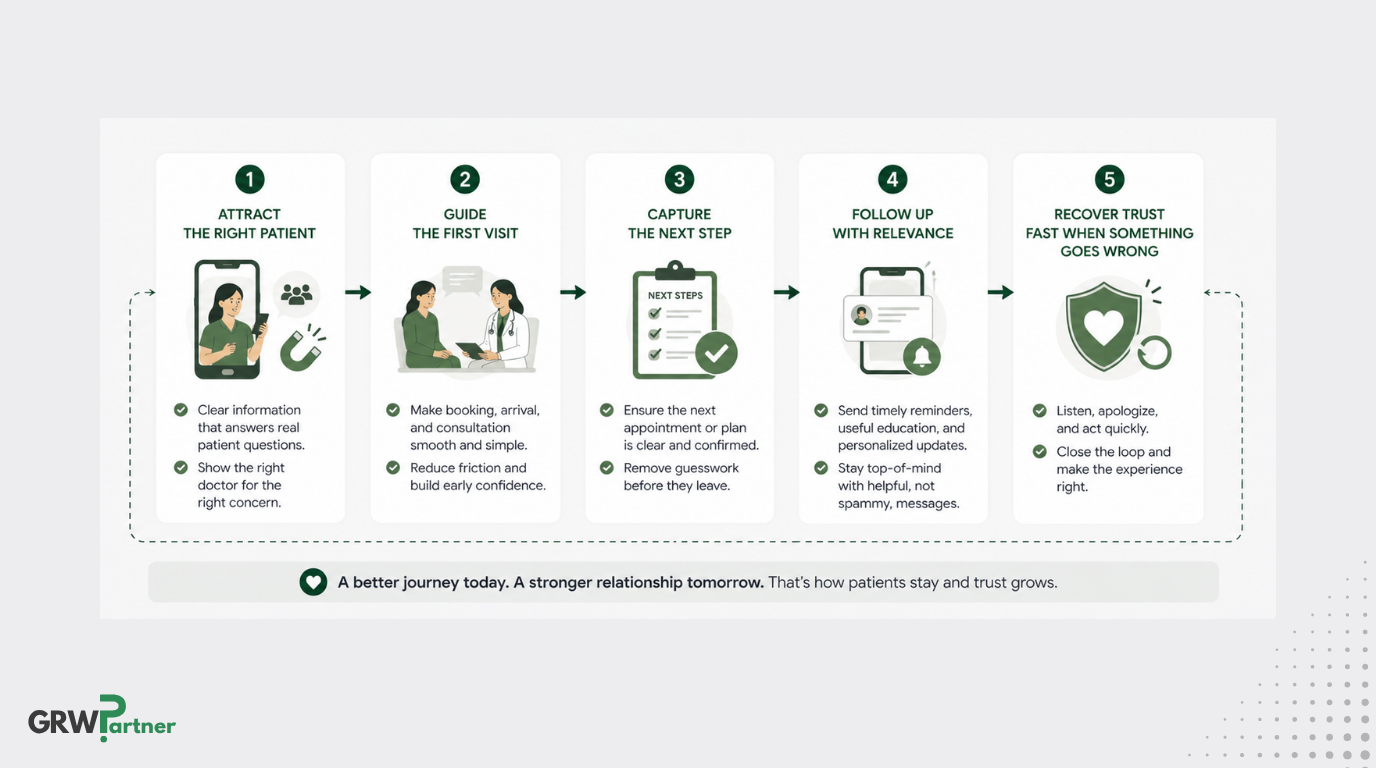


This does not require a massive transformation at the beginning.

Start with one flagship journey. For example, outpatient dermatology, dental, maternity, diabetes, hypertension, pediatric vaccination, or post-surgery recovery. Map the whole experience. Fix the confusing parts. Create follow-up messages. Train the admin. Align the doctor explanation. Make the next appointment easy. Track who returns.

Then turn that system into a brand promise.

For example:

“We do not only treat your skin once. We guide your skin recovery journey.”

“We do not only check your blood pressure. We help you stay consistent.”

“We do not only deliver your baby. We support the pregnancy journey from first trimester to postnatal care.”

This is how retention becomes positioning.

Not a campaign but A system.

What does this mean for healthcare marketing going forward?

Healthcare marketing in Indonesia needs to move from acquisition-first to relationship-first.

The old mindset says: get more leads, run more ads, post more content, give more promos. The better question is: what happens after the first visit?

Because if the clinic keeps attracting new patients but cannot retain them, marketing becomes expensive noise. Every month starts from zero again. The team celebrates leads, but the business does not build compounding trust. Patient loyalty is not built by saying, “We care.”

It is built when the patient feels care in the process. The admin reply. The waiting update. The doctor explanation. The pharmacy instruction.

The follow-up message. The next appointment. The complaint recovery. The family communication. The continuity.

That is where loyalty starts to exist. And for clinics or hospitals in Indonesia, this is probably the real competitive advantage now: not only having good doctors, good products, or good technology, but building a patient journey that makes people say:

“I know where to go next time.”

Start a Conversation

Tell us what you’re trying to solve.
We’ll help you identify the right direction before any execution.

Similar Insight

Forex Broker Marketing SEA South East Asia: Why Most Expansion Plans Fail

One day in 2024, my LinkedIn beeped with a message: “Hey, we...

Do Forex Brokers and Fintechs Really Need OOH in Indonesia?

Let’s be honest here. OOH like billboards, digital OOH, and ...

Does Spread Matter for Indonesian Forex Traders? Not Always at First, But Eventually It Does

“Does spread matter? What is spread, actually?” asked one tr...

Should Clinics Give Discounts for Good Google Reviews?

Should clinics give discounts for good Google reviews or soc...